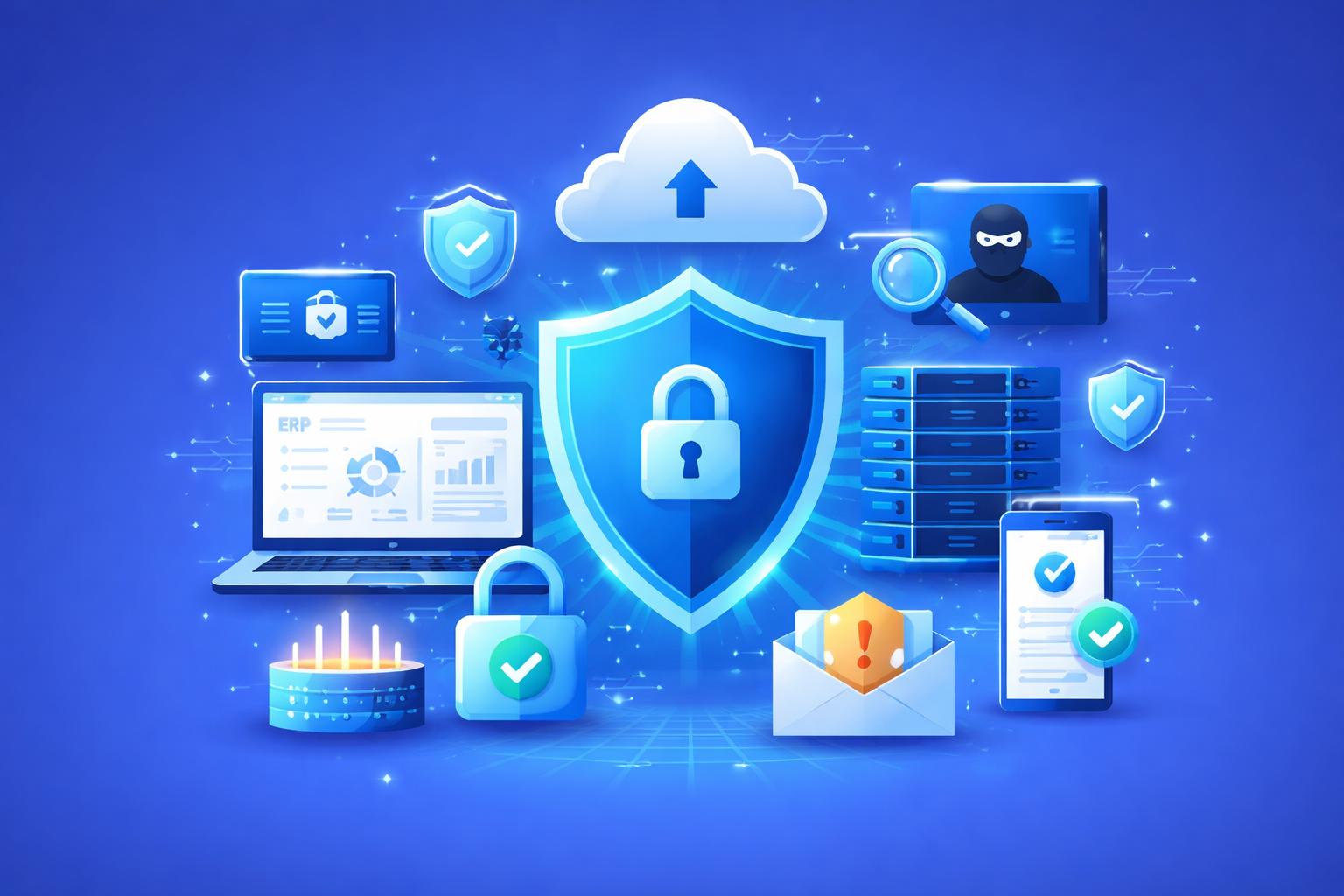
The shift of businesses to web-based ERP systems has brought immense flexibility, accessibility, and cost reduction. However, one of the most common questions is: how secure is the data?
There are many myths surrounding the security of web ERP systems that create fear or misconceptions. In this article for eFluper, we clarify what is true and what is not.
☁️ Myth #1: “Cloud data isn’t secure”
This is perhaps the most widespread myth.
✔️ The truth
Modern web ERPs use:
Data encryption
Secure protocols (HTTPS)
Firewalls and advanced monitoring
In fact, cloud data is often more secure than a local server in an office, which may lack even basic security measures
🌐 Myth #2: “If the internet goes down, I lose my data”
Many fear that relying on the internet means risking data loss.
✔️ The truth
Data is stored on servers, not in the browser
Automatic backups are in place
Connection loss only affects access, not storage
In other words: you may temporarily lose access, but your data remains safe.
🧑💻 Myth #3: “Web ERPs are easier targets for hackers”
The logic behind this myth is that “since it’s online, it’s exposed.”
✔️ The truth
Yes, it’s online—but:
Protected with authentication layers
Role-based access is enforced
Attack detection systems are in place
Moreover, serious providers continuously invest in security—something a small business can hardly do on its own.
🏢 Myth #4: “Only big companies need security”
A dangerous misconception.
✔️ The truth
SMEs are often:
Easier targets
Less protected
Without a clear security policy
An ERP contains:
Financial data
Customer information
Invoices and transactions
This data has value—regardless of business size.
🔑 Myth #5: “One password is enough protection”
Perhaps the most dangerous myth.
✔️ The truth
Modern security requires:
Strong passwords
Two-factor authentication (2FA)
Limited user access
A simple password can be easily breached—especially if reused.
⚠️ Real risks to watch out for
Instead of fearing the wrong things, focus on real risks:
👤 Human error
Incorrect permissions
Sending data to the wrong person
Poor password management
Humans are often the weakest link.
🔧 Poor implementation
An ERP may be theoretically secure, but:
Wrong configuration
Outdated versions
Poor development
…can create vulnerabilities.
🔄 Lack of updates
Security is not “set and forget.”
It requires:
Regular updates
Monitoring
Testing
🛡️ Best practices for a secure web ERP
1.Use a trusted provider
Choose solutions that:
Have proven experience
Provide SLAs
Invest in security
For example, eFluper emphasizes secure infrastructure and modern practices.
2. Manage permissions properly
Don’t give everyone access to everything.
Role-based access
Restrict sensitive data
3. Train your team
Security isn’t just technology.
Phishing awareness
Proper password use
Basic security practices
4. Regularly back up data
Even the most secure system needs a backup strategy.
🚀 The future of ERP security
Security is constantly evolving with technologies like:
AI-based threat detection
Behavioral analytics
Zero-trust architectures
Modern ERPs aren’t just management tools—they are comprehensive platforms integrating advanced protection layers.
✍️ Conclusion
Data security in web ERP is not about “cloud vs local.” It’s about:
Proper implementation
Good practices
Continuous improvement
Myths create fear, but the reality is clear: a properly designed web ERP can be extremely secure.
For eFluper, security isn’t just a feature—it’s a core requirement for trust and business growth.
And ultimately, that’s what matters most.
👉 Sign up for free and try all the features of eFluper.