🌐 The need to connect ERP and e-commerce
In the modern digital market, more and more businesses operate through online stores. E-commerce enables product sales to customers across the country or even internationally. However, as orders and customers increase, managing business data without the right tools becomes more difficult.
This is where an ERP system plays an important role. An ERP (Enterprise Resource Planning) helps businesses centrally manage operations such as invoicing, warehouse management, customers, orders, and financial data. When e-commerce is properly connected with an ERP, all information is automatically synchronized, making business management much simpler and more efficient.
🔗 What does e-commerce and ERP integration mean?
Connecting an online store with an ERP means that data is automatically transferred between the two systems. For example, when a customer places an order in the e-shop, the order can be automatically recorded in the ERP without manual input.
This helps businesses avoid errors, save time, and always maintain updated stock, sales, and customer data. At the same time, the ERP can update the e-shop about product availability, prices, or inventory changes.
Proper system integration creates a unified management environment where all information is synchronized and easily accessible.
⚙️ The role of API in system integration
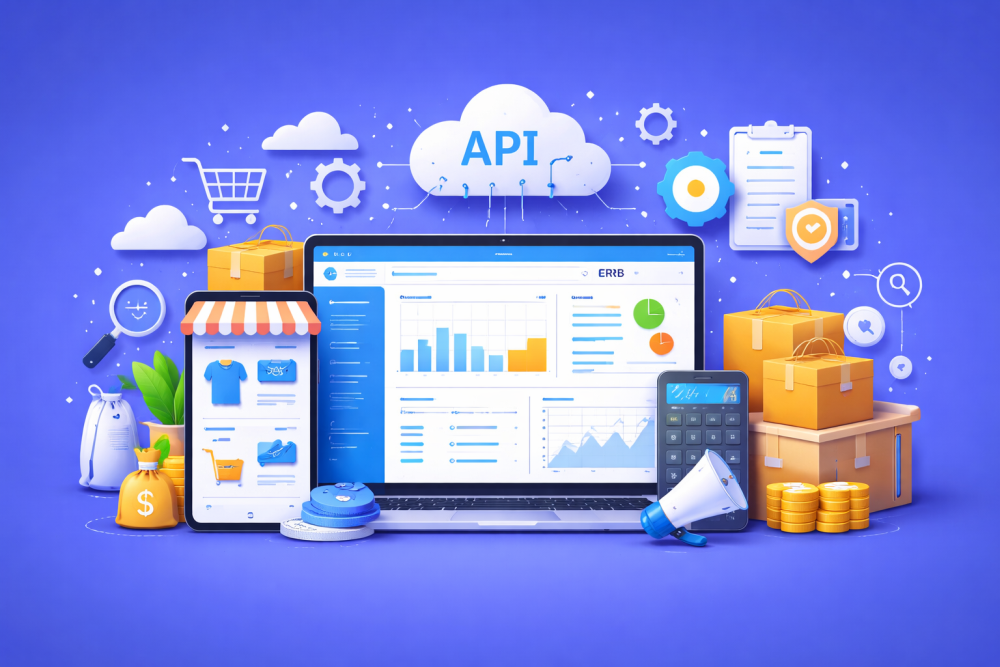
One of the main ways to connect an ERP with an online store is through API. API (Application Programming Interface) allows different applications to communicate and exchange data securely and quickly.
Through an API, an e-shop can send information to the ERP, such as new orders, customer details, or product updates. Similarly, the ERP can return data such as pricing, inventory levels, or invoicing information.
The use of API is particularly important because it provides flexibility to businesses. It is not necessary to use a specific e-commerce platform. Instead, the ERP can connect with many different applications.
🚀 The API of eFluper for application integration
eFluper is a modern web ERP that provides a powerful and flexible API for integration with other applications. Through the API, eFluper can easily connect with any online store or external system.
This means that businesses using platforms such as WooCommerce, Shopify, or custom e-shops can connect their store with the ERP without limitations. The API enables real-time data exchange, ensuring that all information remains updated.
In this way, eFluper functions as the central business management system, while the e-shop continues to serve as the primary sales channel.
📦 Warehouse and product management
One of the biggest advantages of e-commerce and ERP integration is proper inventory management. When a product is sold in the e-shop, the ERP can automatically update available stock.
This helps businesses avoid problems such as selling products that are not available. At the same time, product management becomes much more organized since all information is centralized in one system.
Businesses can also manage prices, discounts, and product categories more easily through the ERP, while the e-shop updates automatically.
🧾 Order and invoicing automation
E-commerce and ERP integration also allows automation of many processes. For example, when an order is completed in the online store, the ERP can automatically generate the corresponding invoice.
This significantly reduces order processing time and minimizes human errors. Staff members do not need to manually enter information since all data is automatically transferred from the e-shop to the ERP.
These automations enable businesses to handle more orders with lower cost and greater accuracy.
📊 Centralized data and reporting management
Another major advantage is centralized business data management. All information regarding sales, customers, and products is stored in the ERP.
This allows businesses to generate reports and statistics that help better understand sales performance and customer behavior. Business owners can monitor in real time metrics such as the most popular product categories, sales by period, or order value.
Proper data analysis can significantly support strategic decision-making and business growth.
💡 A complete ecosystem for e-commerce
Connecting e-commerce with ERP creates a complete business management ecosystem. The online store functions as the customer-facing sales point, while the ERP manages internal operations.
With the powerful API of eFluper, businesses can easily connect their online store with the ERP and automate important functions. Proper system integration helps reduce management time, avoid errors, and improve overall efficiency.
In a world where e-commerce is constantly growing, having a flexible ERP that can connect with any application is a significant competitive advantage for every modern business.
👉 Sign up for free and try all features of eFluper.