🧩 What an ERP is and why it matters
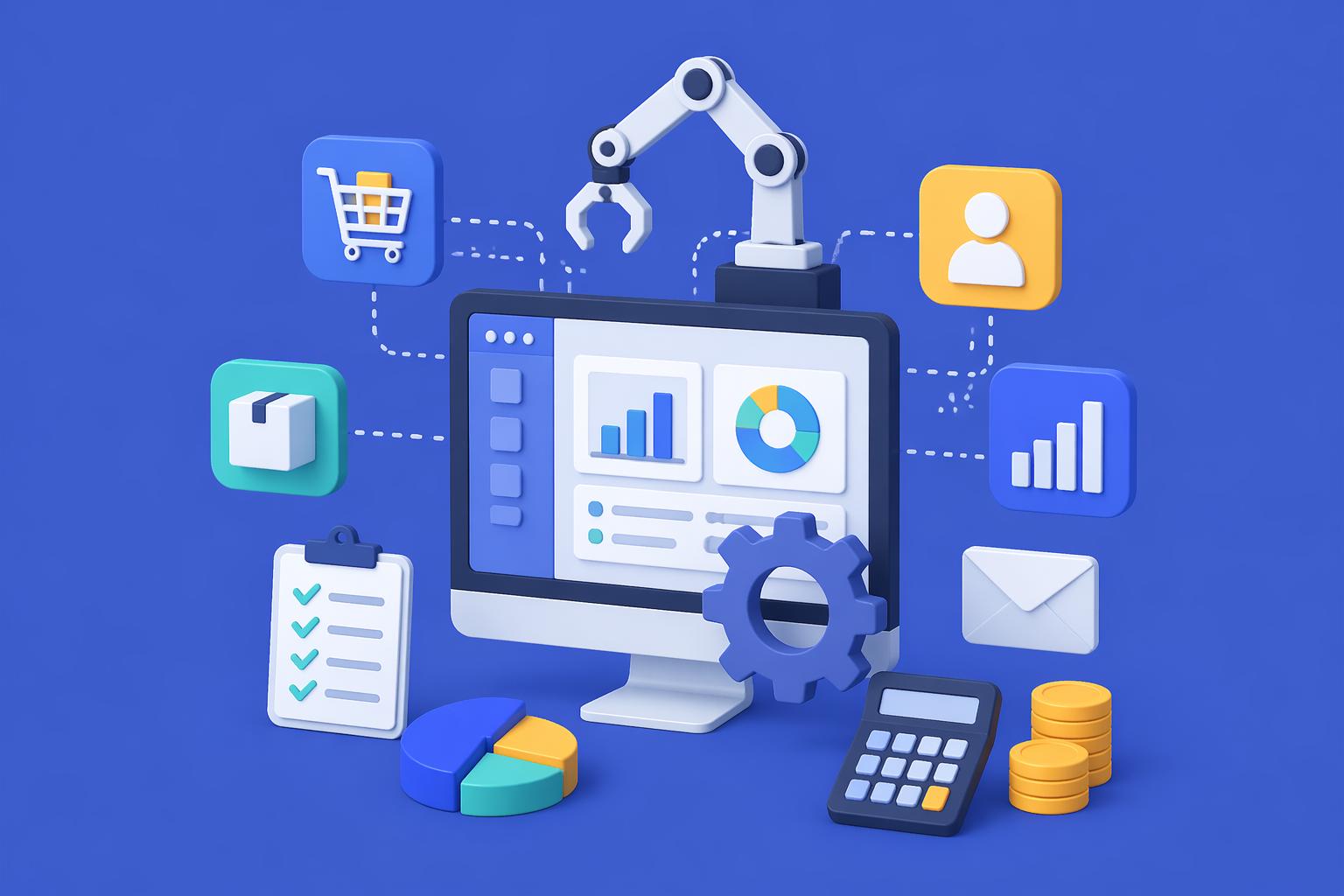
An ERP (Enterprise Resource Planning) system is an integrated information system that connects all core business functions: finance, warehouse, sales, human resources, production, and procurement.
In essence, it acts as the “central brain” of a business, where all data is collected and updated in real time.
When automations are added to such a system, business performance can change dramatically.
⚙️ What automations in an ERP are
Automations are predefined rules or workflows that run without human intervention.
For example:
Automatic invoice creation after a sale
Inventory updates when an order is completed
Sending emails to customers when order status changes
Approval of expenses based on predefined limits
These processes reduce the need for manual work and minimize errors.
🚀 How productivity increases
⏱️ 1. Time savings
One of the biggest advantages of automation is speed.
Tasks that previously took hours (e.g. data entry, reconciliations, file updates) can now be completed in seconds.
This allows employees to focus on more important activities such as strategy, customer service, and sales growth.
❌ 2. Reduction of human errors
Manual data entry always carries a risk of mistakes: incorrect amounts, duplicate entries, or forgotten actions.
ERP automations eliminate this issue because they operate based on rules rather than human memory.
The result is more reliable data and better business decisions.
📊 3. Better information flow
In many companies, information gets “stuck” between departments.
With an ERP that includes automation:
Sales automatically updates inventory
Inventory updates procurement
Finance is updated instantly
This creates a continuous, delay-free flow of information.
💰 4. Lower operational costs
The less manual work required, the lower the operational costs.
Companies don’t need extra staff for repetitive tasks, while costs related to errors (e.g. returns, incorrect billing) are also reduced.
📈 5. Improved decision-making
ERP automations enable real-time data.
This means managers are not relying on outdated reports but seeing what is happening now.
As a result, they can:
React faster to market changes
Detect issues before they become serious
Make more strategic decisions
🔄 Real-world automation examples
🛒 Sales
When an order is completed:
an invoice is automatically generated
inventory is updated
the CRM system is updated
📦 Warehouse
When stock drops below a threshold:
an automatic purchase order is created
the procurement manager is notified
💼 HR
When an employee logs working hours:
overtime is calculated automatically
payroll is updated
🧠 The role of artificial intelligence in ERP
Modern ERP systems go beyond simple automation.
With AI integration they can:
forecast product demand
detect anomalies in financial data
suggest workflow optimizations
This takes productivity to an even higher level.
🏁 Conclusion
Automations inside an ERP are not just a technological improvement — they are a strategic growth tool.
They help businesses:
work faster
make fewer mistakes
reduce costs
make better decisions
In an increasingly competitive environment, automation is no longer a luxury. It is a necessary condition for productivity and sustainable growth.
👉 Sign up for free and try all the features of eFluper.