🏭 Introduction
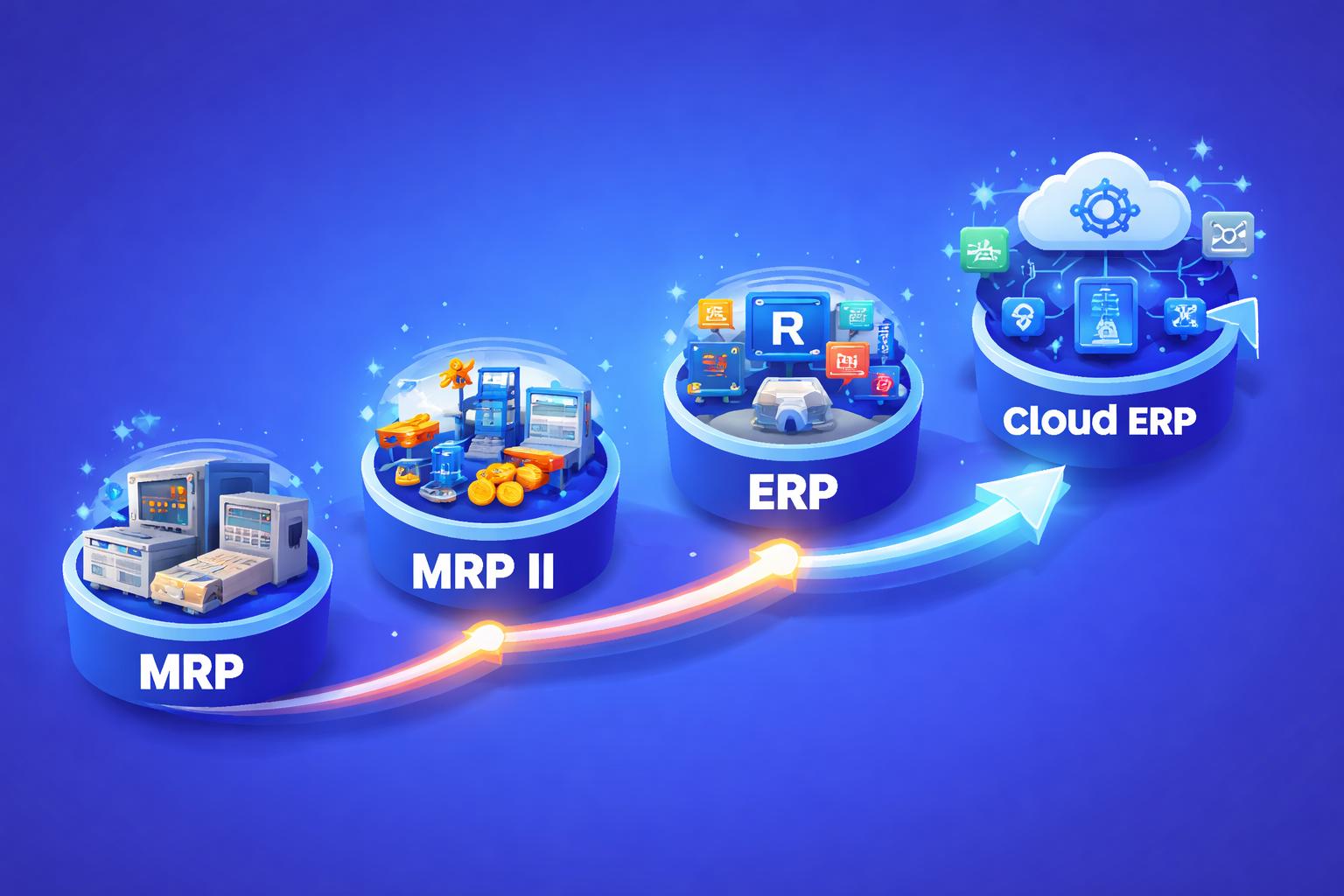
ERP (Enterprise Resource Planning) systems today form the “digital backbone” of businesses, connecting processes such as finance, warehouse management, production, human resources, and sales into a single unified system. However, their journey to the modern form has been long and marked by significant technological changes. From simple inventory management tools, they have evolved into comprehensive cloud platforms that support real-time decision-making.
⏳ The beginning: MRP and the first steps (1960–1970)
The history of ERP begins with MRP (Material Requirements Planning) systems.
The main goal of these early systems was:
👉 to calculate the raw material requirements for production.
Businesses at that time used large mainframe computers, and MRP systems mainly helped reduce inventory levels and improve production processes.
🔹 Limitations:
Focus only on production
Lack of integration with other departments
Difficulty in adaptation
⚙️ MRP II: Expansion into manufacturing (1980s)
In the 1980s, MRP II (Manufacturing Resource Planning) emerged.
This evolution expanded beyond materials to include:
production scheduling
machine and capacity planning
financial analysis of production
💡 For the first time, companies began to see production as an integrated system rather than isolated processes.
However, these systems were still “localized” and not fully integrated across the enterprise.
🧩 The birth of ERP (1990s)
The 1990s marked the creation of the ERP concept.
ERP systems did something revolutionary:
👉 they unified all business departments into a single platform.
Finance, HR, warehouses, and sales were now interconnected.
🔹 Key features:
Centralized database
Data integration
Improved interdepartmental collaboration
📌 Companies such as SAP and Oracle became pioneers in the field, offering comprehensive solutions for large organizations.
🌐 ERP and the internet era (2000s)
With the spread of the internet, ERP systems changed dramatically.
New features included:
Web-based access
Better communication between branches
Integration with customers and suppliers
💻 For the first time, businesses could access their data from multiple locations.
Additionally, new modules emerged:
CRM modules (Customer Relationship Management)
SCM modules (Supply Chain Management)
ERP became a strategic tool, not just an operational one.
☁️ The cloud ERP era (2010–today)
The biggest change in recent years is the shift to the cloud.
Modern ERP systems offer:
access from anywhere
lower infrastructure costs
automatic updates
high data security
🚀 Cloud ERP has enabled small and medium-sized businesses to access tools that were previously available only to large enterprises.
Examples of modern trends include:
SaaS models (Software as a Service)
mobile ERP applications
real-time analytics
🤖 ERP and artificial intelligence
Today, ERP systems are evolving further with Artificial Intelligence (AI) and machine learning.
This means:
demand forecasting
process automation
intelligent data analysis
error and anomaly detection
📊 Businesses no longer just react to data—they use it to predict the future.
📱 Mobile & real-time ERP
Mobility is also a key feature of modern ERP systems.
Employees can:
approve orders from mobile devices
monitor inventory in real time
receive instant notifications
⚡ This increases decision-making speed and reduces delays.
🔐 Security and regulatory compliance
With the growth of data, security has become critical.
Modern ERP systems provide:
data encryption
role-based access control
compliance with GDPR and other standards
🔒 Data protection is now a fundamental part of any ERP system.
📈 The future of ERP
The future of ERP systems looks even more advanced.
Expected developments include:
full automation of business processes
integration with IoT devices
more advanced AI-driven decision-making
unified enterprise management ecosystems
🌍 ERP is transforming from a management tool into the “digital brain” of the enterprise.
🧾 Conclusion
The evolution of ERP from simple MRP systems to modern cloud and AI-driven platforms clearly reflects the technological progress in business environments.
📌 From production → to integration → to intelligence.
Today, ERP is not just software. It is the operational core of every modern business, connecting people, data, and decisions into a unified digital ecosystem.
👉 Sign up for free and try all of eFluper’s features.