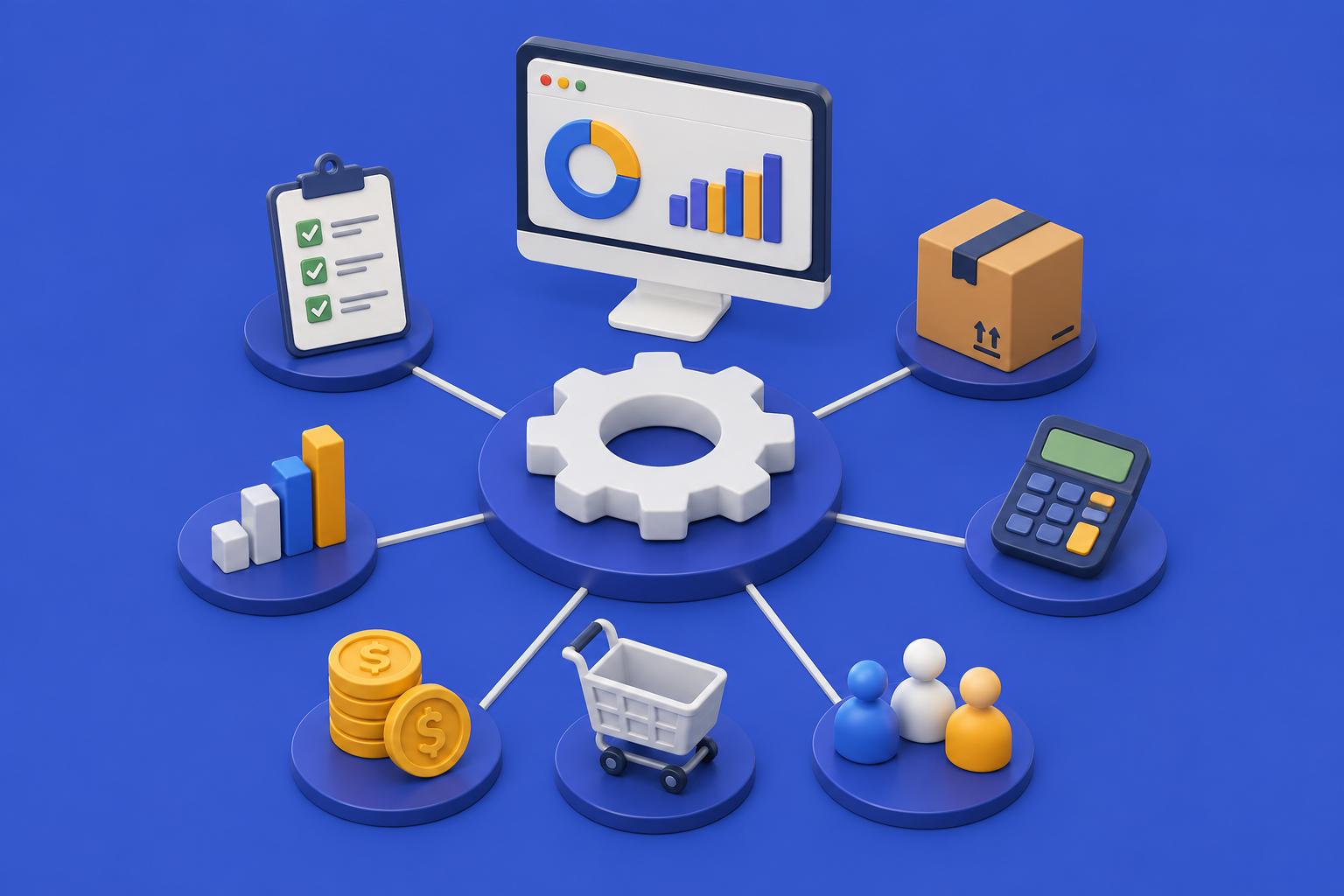
As your business grows, so do the challenges of managing daily operations. While spreadsheets and standalone software may work in the early stages, they often become inefficient as your company expands. An Enterprise Resource Planning (ERP) system integrates your core business processes into one centralized platform, helping you improve efficiency, reduce errors, and make better decisions.
If you're wondering whether it's time to invest in an ERP solution, here are 10 clear signs your business is ready.
📊 Your data is scattered across multiple systems
If your sales, accounting, inventory, and customer information are stored in different applications or spreadsheets, finding accurate information becomes time-consuming and frustrating.
An ERP system centralizes your business data, giving every department access to the same up-to-date information.
⏳ Employees spend too much time on manual tasks
Are your teams repeatedly entering the same information into different systems? Manual data entry not only wastes valuable time but also increases the risk of human error.
An ERP automates repetitive processes, allowing employees to focus on higher-value activities.
📦 You struggle to track inventory
Running out of stock unexpectedly or over-ordering products can significantly impact your profitability and customer satisfaction.
An ERP provides real-time inventory visibility, helping you maintain optimal stock levels and improve supply chain management.
💰 Financial reporting takes too long
If preparing financial reports requires collecting data from multiple sources, decision-making becomes slow and inefficient.
With an ERP, financial information is updated automatically, enabling real-time reporting, cash flow monitoring, and more accurate forecasting.
👥 Departments don't communicate effectively
When sales, finance, purchasing, and warehouse teams work in separate systems, communication gaps often lead to delays and costly mistakes.
An ERP connects every department, ensuring everyone works with the same accurate information.
📈 Your business is growing faster than your processes
Business growth is exciting, but it also increases operational complexity. As orders, customers, and employees increase, outdated processes become difficult to manage.
An ERP scales alongside your business, supporting growth without adding unnecessary administrative work.
⚠️ Errors are becoming more frequent
Duplicate records, incorrect invoices, missed orders, and inconsistent data can damage your reputation and reduce customer trust.
By automating workflows and eliminating duplicate data entry, ERP systems significantly reduce human error.
📱You can't access business information outside the office
Modern businesses require flexibility. If you need to be physically present in the office to review reports or approve transactions, productivity suffers.
Cloud-based ERP solutions provide secure access to business information anytime, from any device.
📊 Business reports are difficult to generate
If creating reports requires hours of exporting spreadsheets and combining data manually, you're spending valuable time gathering information instead of analyzing it.
An ERP generates real-time dashboards and customizable reports, giving management immediate insights into business performance.
🚀 Your current systems are holding back growth
When your existing software can't support new business requirements, expansion becomes more challenging than it should be.
An ERP provides the digital foundation needed to improve operational efficiency, enhance customer service, and support long-term business growth.
✅ Conclusion
If several of these signs sound familiar, it may be time to consider implementing an ERP system. Rather than simply replacing existing software, an ERP transforms the way your business operates by connecting every department, automating routine tasks, and providing complete visibility across your organization.
The right ERP solution helps reduce operational costs, improve productivity, strengthen collaboration, and enable faster, data-driven decision-making. More importantly, it prepares your business for sustainable growth, allowing you to scale confidently while maintaining efficiency and delivering better experiences for your customers.
Investing in an ERP today isn't just about solving current operational challenges—it's about building a stronger, smarter, and more competitive business for the future.
👉 Sign up for free and try all the features of eFluper.