Choosing an ERP system is one of the most important decisions for a business. ERP serves as the “heart” of a company’s operations, managing processes such as invoicing, customer management, inventory, finance, and reporting.
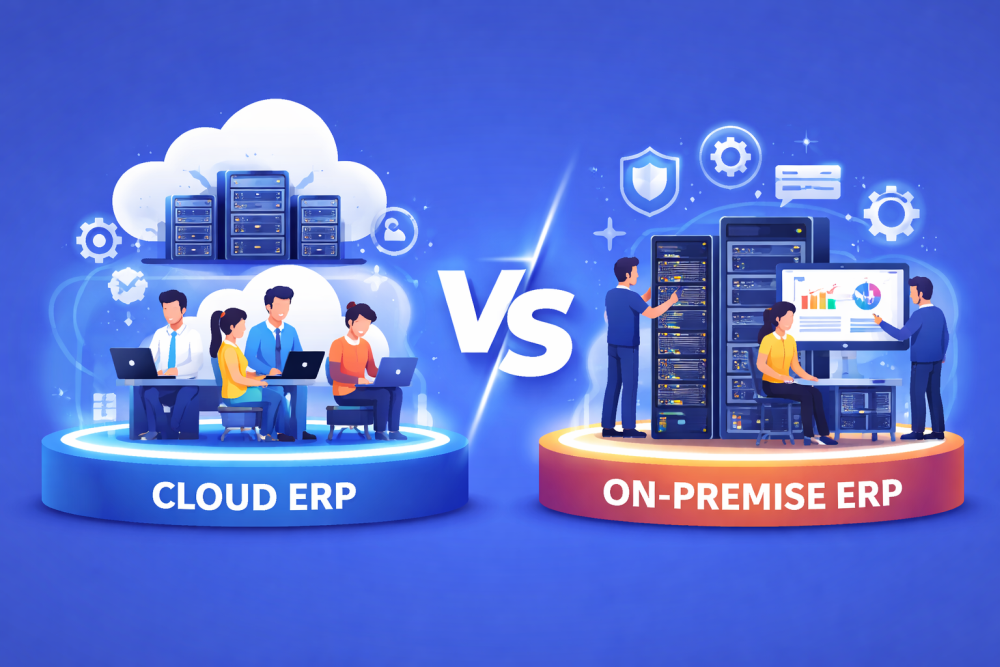
Today, businesses have two main options: Cloud ERP or On-Premise ERP. But what’s the real difference, and which solution is more cost-effective?
In this article, we’ll explain in simple terms the advantages and disadvantages of each choice.
🖥️ What is On-Premise ERP?
On-Premise ERP is the traditional software installation model. In this case, the system is installed on the company’s own servers.
This means the business:
Purchases a software license
Owns a server or IT infrastructure
Handles system maintenance and security internally
It is typically used by large companies with an internal IT team and full control over their infrastructure.
Advantages:
✔ Full control over data
✔ Customization according to company needs
✔ No internet connection required for local use
Disadvantages:
❌ High initial installation cost
❌ Requires server and technical support
❌ Updates and maintenance managed internally
❌ Limited access outside the office
For many small and medium-sized businesses, these drawbacks can make On-Premise ERP expensive and less practical.
☁️ What is Cloud ERP?
Cloud ERP operates over the internet and is hosted on cloud servers. Users can access the system via a browser without any installation.
This means the business does not need to purchase a server or manage technical infrastructure.
Today, cloud-based services are everywhere: email, file storage, CRM, and of course, ERP.
Advantages:
✔ Access from anywhere (office, home, mobile)
✔ Lower initial cost
✔ Automatic updates
✔ No server or IT infrastructure required
✔ Easy to scale as the company grows
Disadvantages:
❌ Requires an internet connection
❌ Data is stored on external servers
❌ Reliant on the service provider
However, most modern cloud ERPs use high-level security measures, often stronger than what a small company could maintain locally.
💰 Cost Comparison
Cost is one of the key factors in choosing an ERP.
On-Premise ERP:
Initial costs usually include:
Software license purchase
Server purchase
Installation
Customization
Technical support
The total cost can be quite high upfront.
Cloud ERP:
Cloud ERP typically operates on a subscription model. The company pays:
Monthly or annual subscription
Per user or per package
This makes costs more predictable and lower initially, which is a major advantage for small and medium-sized businesses.
🌍 Access and Flexibility
On-Premise:
Access is usually:
Through the company’s local network
Via VPN if accessing remotely
This can create limitations, especially for businesses with remote teams or partners.
Cloud ERP:
Users can connect from:
Computer
Tablet
Mobile device
Any location
All that’s needed is an internet connection, making business management much more flexible.
🔐 Data Security
Security is often a concern when considering cloud solutions.
Modern cloud infrastructures provide:
Data encryption
Automatic backups
Protection against attacks
Continuous monitoring
In most cases, cloud security exceeds what a small business could achieve on a local server.
For On-Premise ERP, security depends entirely on:
The company’s infrastructure
Software updates
Technical support
⚙️ Updates and Maintenance
Maintaining an ERP system is as important as the initial installation.
On-Premise:
The company is responsible for:
Installing updates
Backups
Server maintenance
Security management
This requires time and resources.
Cloud ERP:
Most of these tasks are handled automatically by the provider. Users simply log in and always have access to the latest system version.
🚀 Which Solution is Better?
The answer depends on the size and needs of the business.
On-Premise ERP is suitable for:
Large enterprises
Organizations with internal IT teams
Businesses with special infrastructure requirements
Cloud ERP is ideal for:
Small and medium-sized businesses
Companies seeking lower initial costs
Teams working remotely
Businesses wanting quick deployment
💡 Conclusion
Market trends clearly show that more and more businesses are choosing cloud ERP solutions for their ease of use, flexibility, and lower costs.
Modern web ERP platforms like eFluper allow businesses to manage all operations online without complex installation or expensive infrastructure.
With access from anywhere, automatic updates, and secure data storage, cloud ERP is a practical and cost-effective choice for many companies’ future growth.
👉 Sign up for free and try all the features of eFluper today.