🧩 What are ERP and POS?
ERP (Enterprise Resource Planning) and POS (Point of Sale) are two of the most important systems in modern business management.
ERP is an integrated information system that manages all core business functions: inventory, accounting, procurement, human resources, and reporting.
POS is the system used at the checkout for completing sales. It handles transaction recording, receipt issuance, and customer service at the point of sale.
🔗 How are ERP and POS connected?
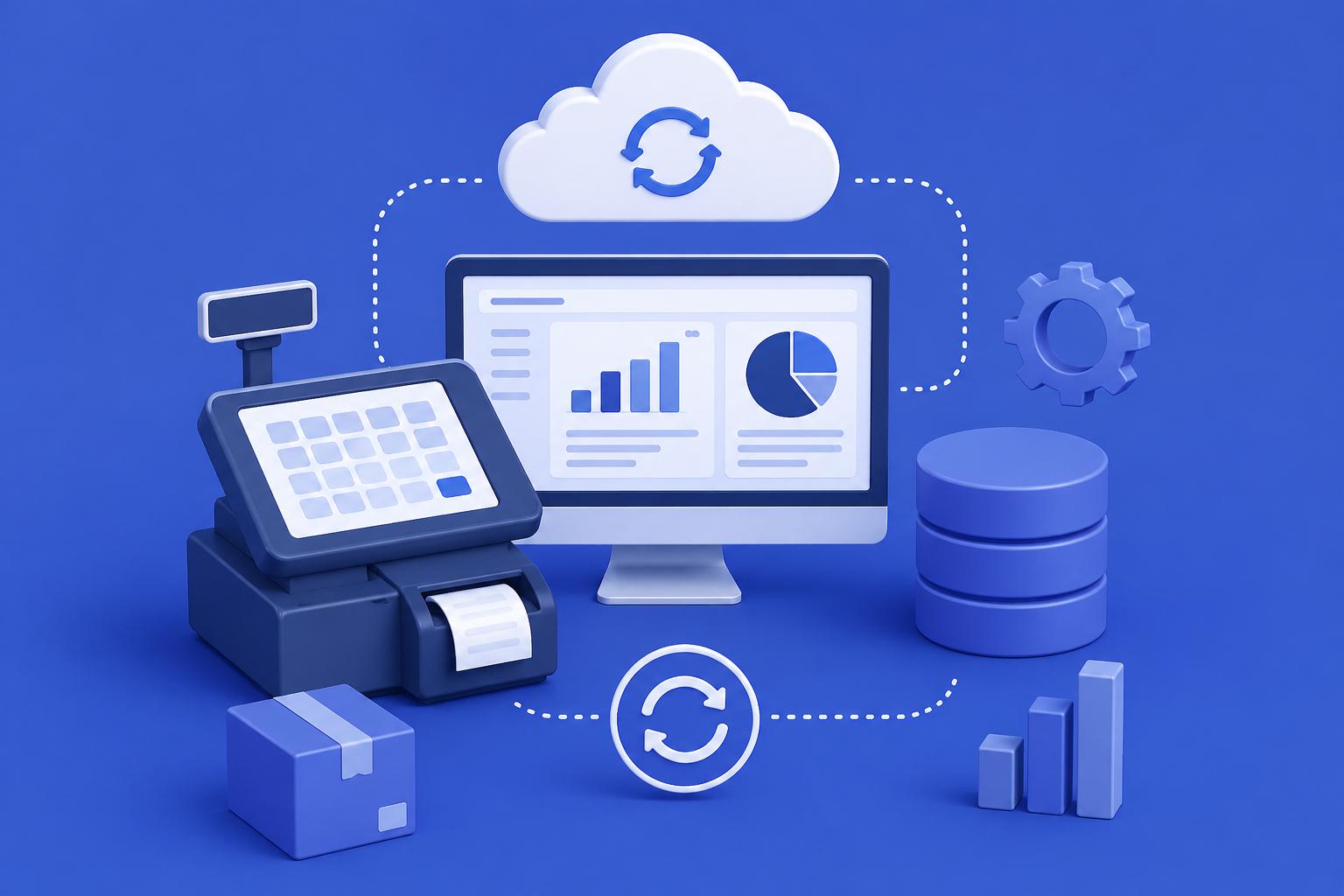
The integration between ERP and POS is now a key factor for the smooth operation of retail, hospitality, and wholesale businesses.
When both systems are connected, every sale made in the POS is automatically updated in the ERP. This means that:
📦 Inventory is updated in real time
💰 Financial data is recorded instantly
📊 Sales reports are always up to date
🧾 Human errors from manual entry are reduced
The integration can be implemented either via cloud systems or local servers, depending on business needs.
⚙️ How integration works in practice
Let’s look at a simple example:
A customer purchases a product at the POS
The POS records the sale
The data is automatically sent to the ERP
The ERP reduces the product stock
Accounting is updated with the revenue
All of this happens in seconds, without manual intervention.
📊 Benefits of ERP – POS integration
Connecting the two systems offers significant advantages:
🚀 1. Process automation
The business reduces manual work and saves time.
📉 2. Fewer errors
Duplicate entries and human mistakes are significantly minimized.
📦 3. Better inventory management
The business always knows exactly what is in stock.
💡 4. Improved decision-making
Real-time data is available for analysis and strategy.
📈 5. Increased productivity
Employees focus on more important tasks instead of data entry.
🏪 Which businesses need it?
ERP and POS integration is especially useful for:
Retail stores
Supermarkets
Restaurants and cafés
Chain stores
E-commerce businesses
The larger the business, the more critical proper system integration becomes.
☁️ Cloud ERP and modern POS systems
In recent years, many businesses have adopted cloud-based solutions.
Cloud ERP allows access from anywhere, while modern POS systems connect easily via the internet.
This provides:
🌍 Real-time access across multiple locations
🔄 Automatic data synchronization
🔐 Improved data security
🔐 Data security
ERP and POS integration must be implemented with strong security protocols.
Key points include:
Data encryption
Regular backups
User access control
Firewalls and network protection
This ensures that business data remains safe and protected.
📌 Conclusion
ERP and POS integration is not just a technological upgrade, but a strategic decision for every modern business.
With proper implementation:
processes become faster
accuracy improves
business control increases
customer experience is enhanced
In an era where speed and information are critical, integrating ERP and POS is the key to growth and competitiveness.
👉 Sign up for free and try all the features of eFluper.