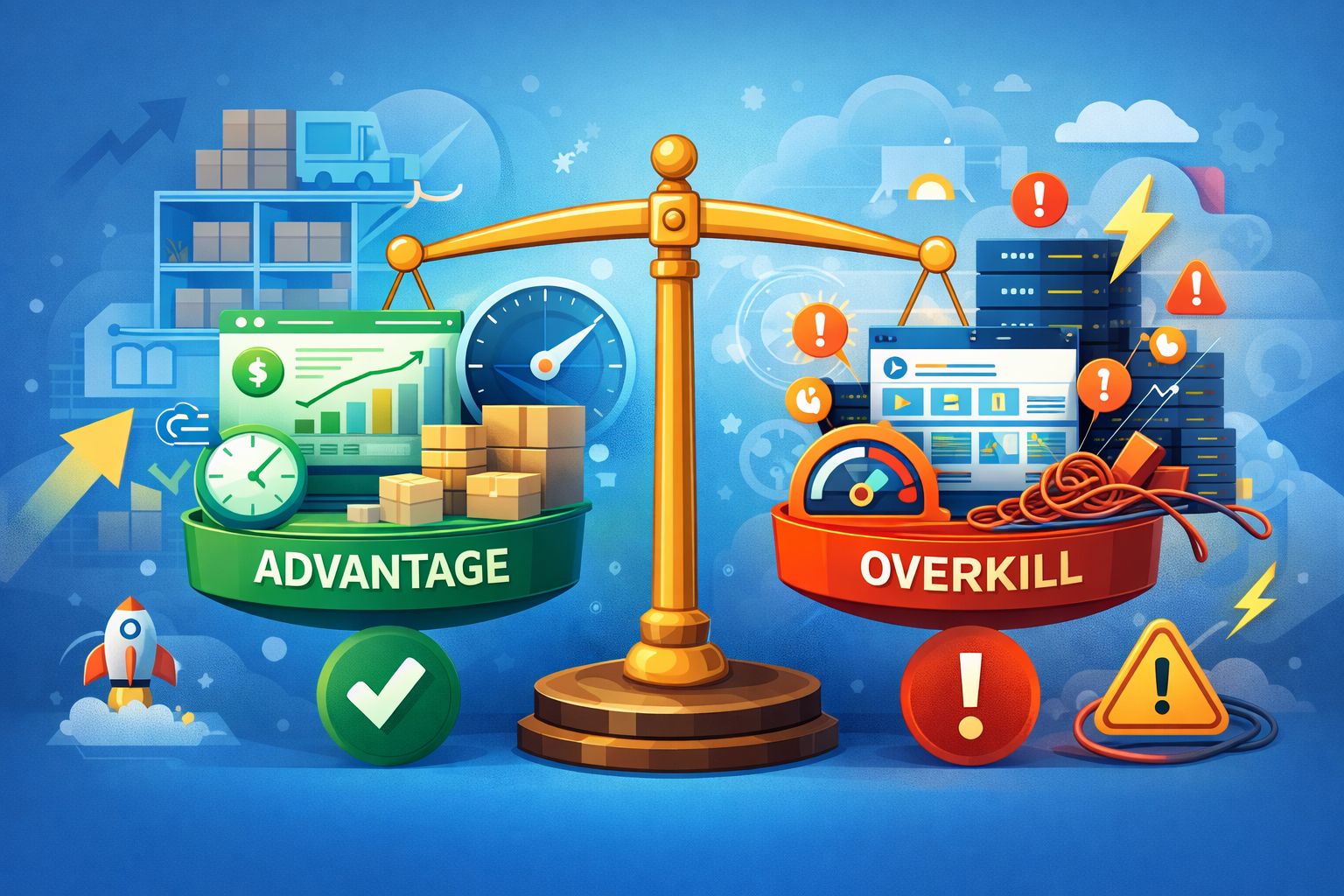
Real-time data: Advantage or overkill for an ERP?
In the world of ERP systems, real-time data is often presented as the ultimate advantage. Dashboards that update continuously, warehouses that change numbers in seconds, “live” financial data.
But is it really necessary? Or, in some cases, is it overkill?
Let’s look at it realistically — from a business perspective, not marketing.
📊 What do we mean by real-time data in an ERP?
Real-time data means:
Every change (sale, purchase, warehouse movement)
Appears immediately in the system
No delays, syncs, or batch updates
The user sees, in the moment, what is happening in the business.
✅ When is it a real advantage?
Real-time data is truly critical when:
🚚 Warehouse & logistics management
Fast sales
Low inventory
Frequent orders
If you don’t know what you have right now, you risk mistakes, delays, and cancellations.
💰 Financial control
Immediate cash flow visibility
Current revenues/expenses
Better decisions without “rough estimates”
🏭 Production & operations
In environments where:
Time is money
Decisions must be immediate
Real-time data isn’t a luxury — it’s a survival tool.
⚠️ When is it overkill?
Not every business needs second-by-second data.
Examples:
Small service businesses
Companies with only a few invoices per day
Businesses reporting once a week
In these cases:
Updates every 5–15 minutes are more than enough
Real-time adds complexity without real benefit
🧠 The hidden cost of real-time ERP
Real-time systems are not free, technically or operationally:
🖥️ Higher load on servers & databases
🔌 More complex architecture
🧑💻 Increased development & maintenance costs
📉 Potential performance issues if not designed properly
And most importantly: more data ≠ better decisions.
📉 Real-time data without context = noise
Many businesses fall into the trap:
"We need to see everything live"
Result:
Dashboards full of numbers
Constant notifications
Stress instead of control
An ERP should:
Filter
Organize
Show what matters
Not everything, all the time.
🎯 The right question isn’t “real-time or not”
The right question is:
Which data actually needs to be real-time?
Example:
Warehouse → real-time ✅
Monthly stats → not necessarily
Cash position → yes
Historical reports → no
A modern ERP should be flexible, not absolute.
🚀 Conclusion
Real-time data in an ERP:
✅ Is a huge advantage when used correctly
⚠️ Becomes overkill when applied without reason
The value isn’t in the speed of the data, but in:
The right information
At the right time
For the right decision
A good ERP doesn’t just show you what’s happening now.
It helps you decide what to do next. 💡
👉 Sign up for free and try all the features of eFluper.